Oregon Organizing Workshop · November 2025

Building Something Together

What the data shows about what we built, what is fading, and what we need to do next.

43 Pre-post survey
participants
21 Six-month
interviews
14 Post-post survey
completers
9 Organizations
represented

We need people power, but we're siloed.

"We have to be in relationship together and it can't be transactional. Sometimes we will argue and bicker, but that is the whole fucking point of relationships. They keep telling us to defeat fascism, we have to create these broad-based coalitions. But we're still in our silos. So how the heck do we do that until we're in these really messy spaces together?" — Civil rights organization executive director, closing the November workshop

The Oregon progressive ecosystem is highly activated but structurally siloed. Organizations and individuals are mobilizing in parallel without the cross-organizational relationships that convert episodic action into durable power.

The November 2025 workshop was designed to answer this question. Here is what we learned.

New leaders.
New relationships.
Cross-organizational connections.
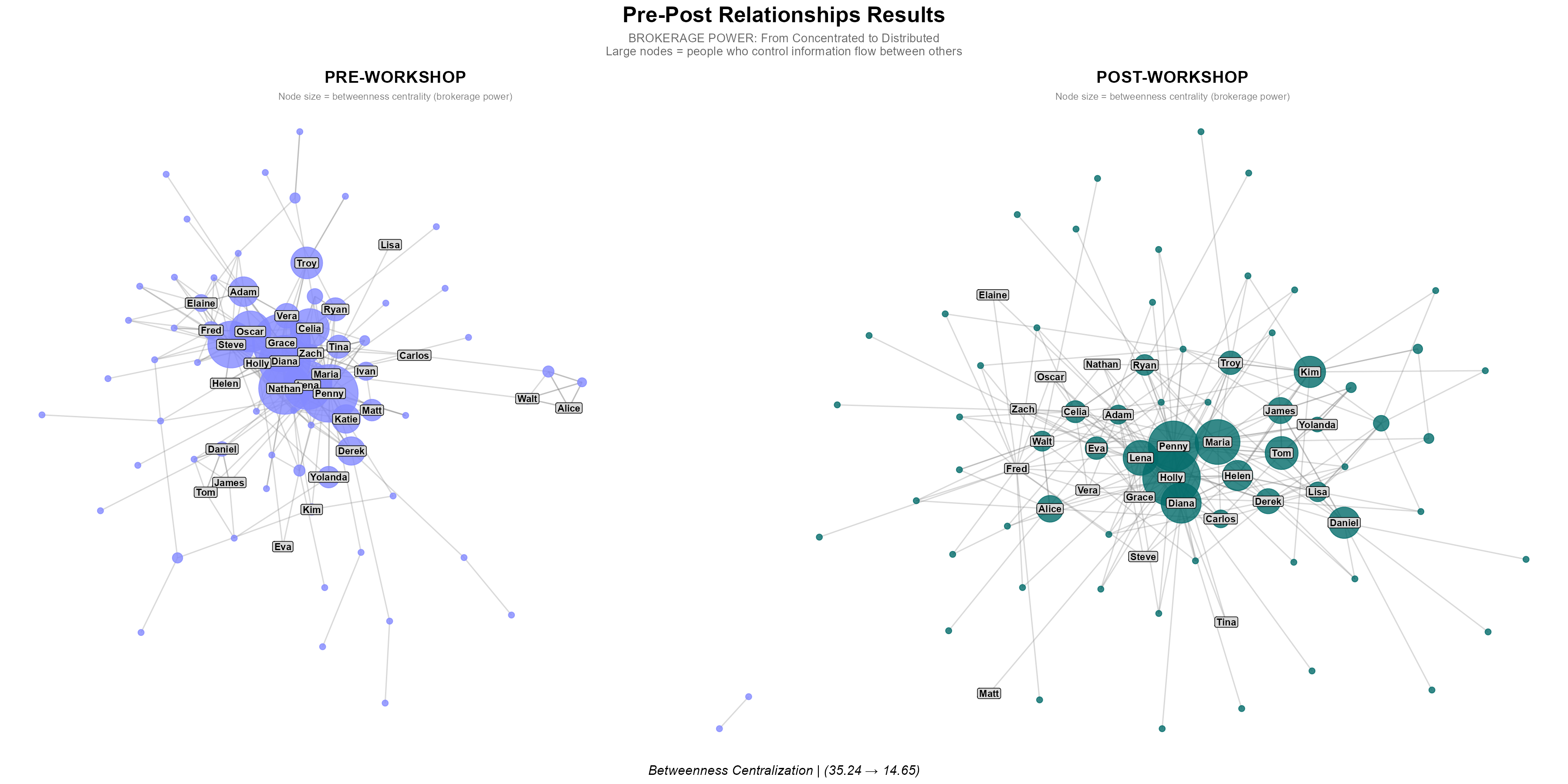
Side-by-side network visualization showing shift
                  from concentrated to distributed brokerage power
Node size = brokerage power (betweenness centrality). Before: concentrated in a few. After: distributed across many. Network covers all workshop participants who completed relationship surveys (pre: 81 nodes, 268 edges; post: 78 nodes, 239 edges including 79 genuinely new ties). Names are pseudonyms.
How to read the network data: Think of leadership like a snowflake: one person at the center connects to others, each of whom connects outward to their own networks. Before the workshop, a few people functioned as hub-and-spoke connectors — all roads led through them. After the workshop, that snowflake structure distributed outward. More people became connectors in their own right, reaching across organizational lines rather than staying within existing clusters.

Before the workshop

A small number of people controlled most of the connections between others. Information and relationship had to flow through a few hubs. The network was cliquey — most connections were within existing organizations and communities.

After the workshop

Brokerage power redistributed to far more participants (−58%). New connections reached across organizational lines — people formed ties with others whose networks they did not already share (−37% clustering).

79 of the connections formed were new: people who had not previously been in each other's "us."

−58% Less hub dependency Brokerage power redistributed from a few central connectors to many participants
−37% Weaker silos New connections more likely to cross organizational and community lines
79 Genuinely new ties Connections that did not exist before the workshop
What made those connections possible
"Stories are the foundation. They create connection across perceived difference, and open the door to everything that follows." — Communications consultant, post-workshop survey
"I am more connected to the members of my local organizing group than before. I feel our working relationship will be more effective together." — Local organizer, post-workshop survey
"Organizing grows from relationships rooted in shared stories. Looking around the room, I named people I had never worked with before — from different organizations, different communities — as part of my 'us.' That is not something that usually happens at a training." — Foundation executive, post-workshop survey
When asked: "Who here now feels part of your 'us'?"
"People from other civil rights organizations across the country — people I never would have met otherwise." — Civil rights organization staff, post-workshop survey
"A civil rights attorney — on some similar challenges we have both shared. I would not have made that connection without this workshop." — Foundation staff, post-workshop survey
"A participant in my breakout group — it involved suicide touching his family, and that's also touched my family. You can't tell by looking at someone what their traumas are. We all have more in common than we think." — Communications consultant, post-workshop survey
"People from other states doing similar work — people I can actually work with going forward." — Civil rights organization staff, post-workshop survey
Real stories and emotions lay the foundation for real relationships.

Vulnerability could be uncomfortable, but it also enabled self-discovery, trust, and connection that wouldn't happen without authentic risk-taking.

"I kind of thought I don't have a very interesting story. But when we sat together in those groups, I was just so impressed by every single person. And then by the time I wrote down my story, I thought — well, my story is interesting too. I never would've found it." — Local organizer, six months later
"The workshop leader's story was compelling and has shifted the way I show up." — City official, post-workshop survey
"For the first time since Trump was re-elected, I felt like I have agency to stand up against fascism and believe in a better future. I feel like I have more control in how I show up in the world." — Civil rights organization staff, post-workshop survey
"Being timed to practice my personal story was uncomfortable but effective. I overcame some of my fear of sharing more about myself." — Foundation staff, post-workshop survey
"It created an odd sense of camaraderie — not even our organizational team because we were all randomized — with these random people I met an hour before." — Civil rights organization staff, six months later
"The workshop leader kicking it off in the way that she did really modeled vulnerability, and I think then kind of opened that up for the rest of the training." — National organizer, six months later
"I am not my identities, rather a human with a story to share with others." — Civil rights organization staff, post-workshop survey
When people share their story — even a little — it is an invitation to be in relationship. That is what made people see each other as resources, not just contacts. That is what made this different from a training.
"That organizing asks not 'what is my issue' but 'who are my people' — this was an important learning for me." — City official, post-workshop survey
"As a white male, I've never thought about my story. I've suppressed it. The workshop opened a door that I think has made me more grounded and certainly more effective." — Indivisible leader, six months later
"The relationship building session was a much needed moment of transformation post-COVID. Many of us lost these key skills, even us as organizers." — Food bank organizer, post-workshop survey

People left more hopeful, more connected, and more oriented toward organizing others.

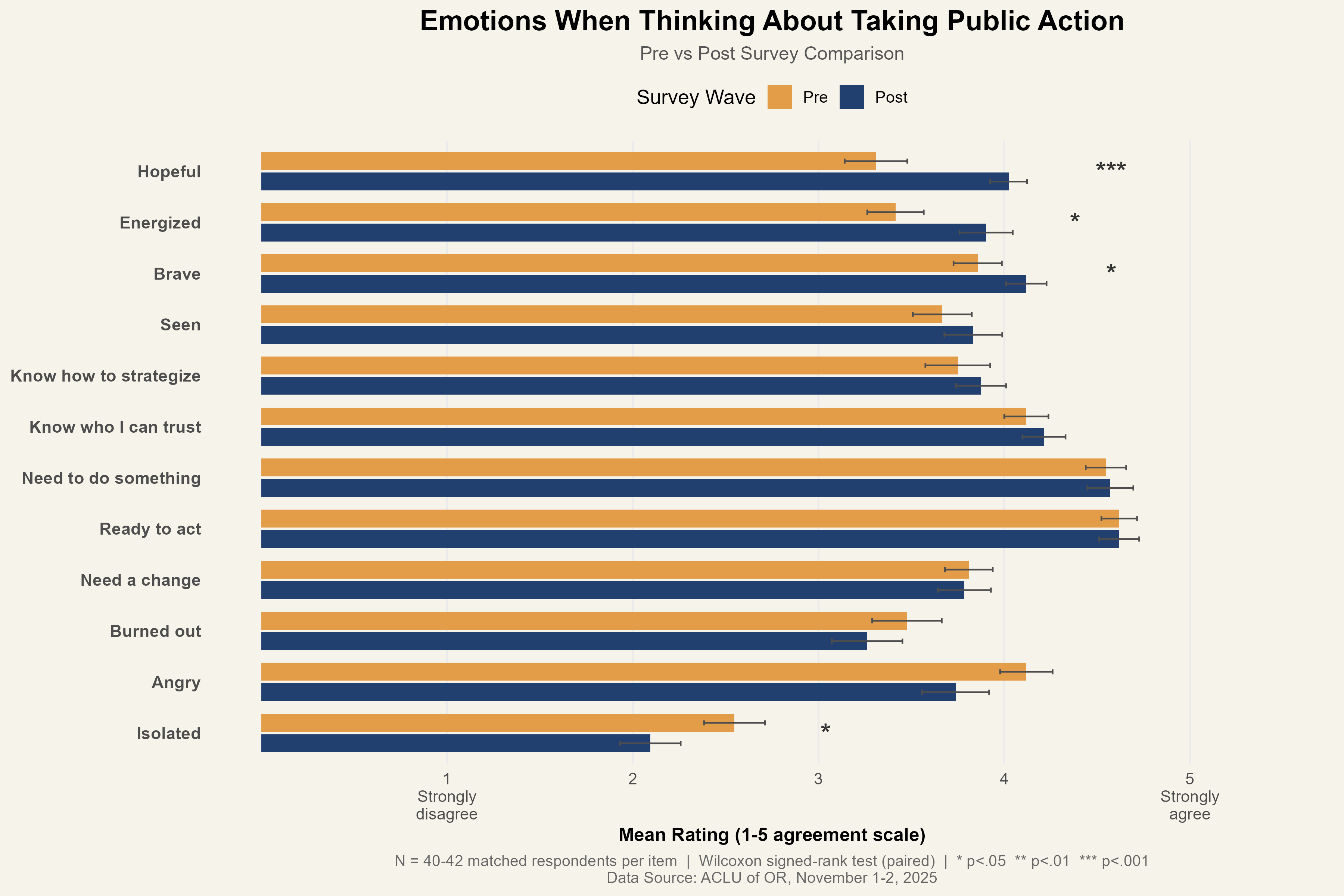
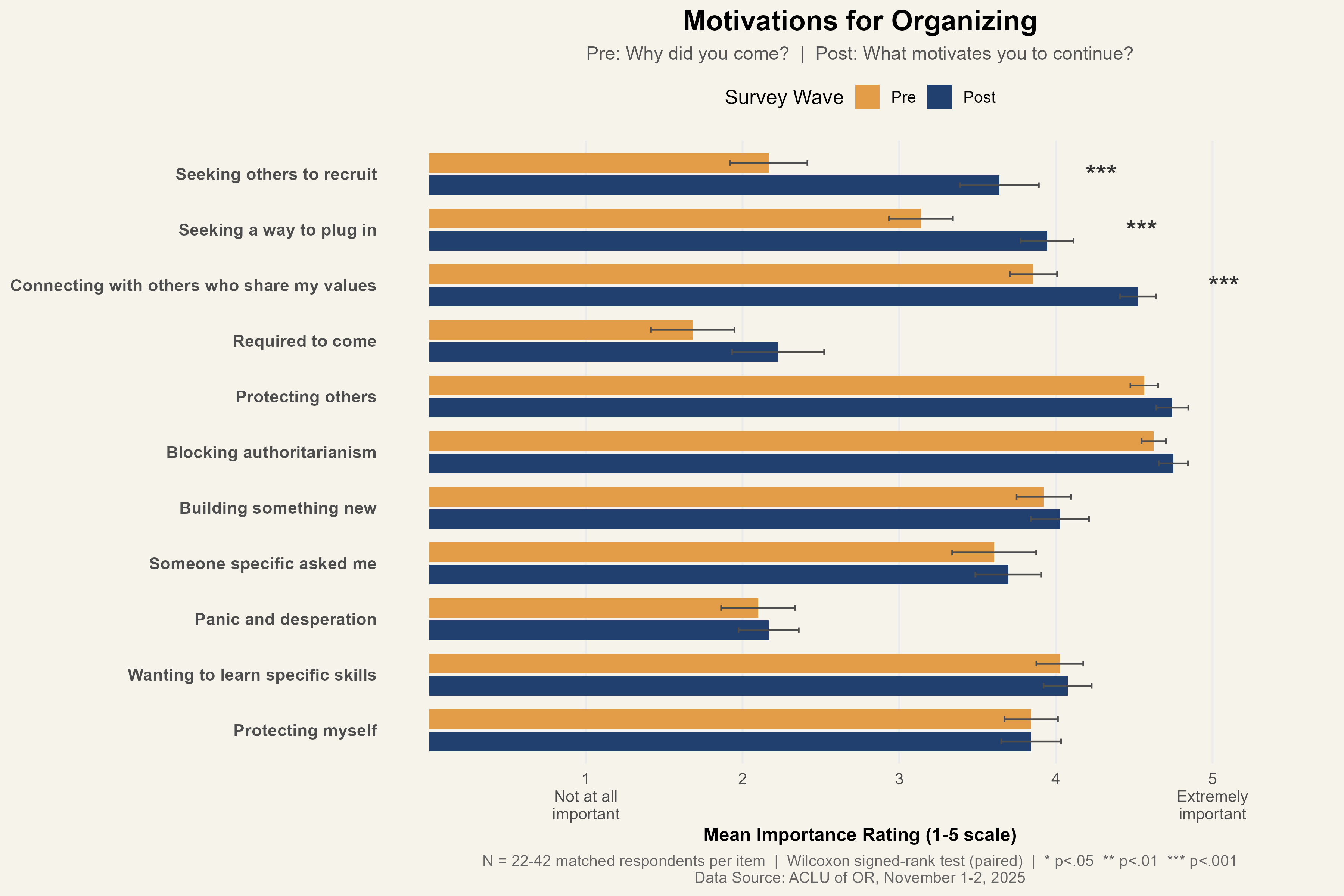
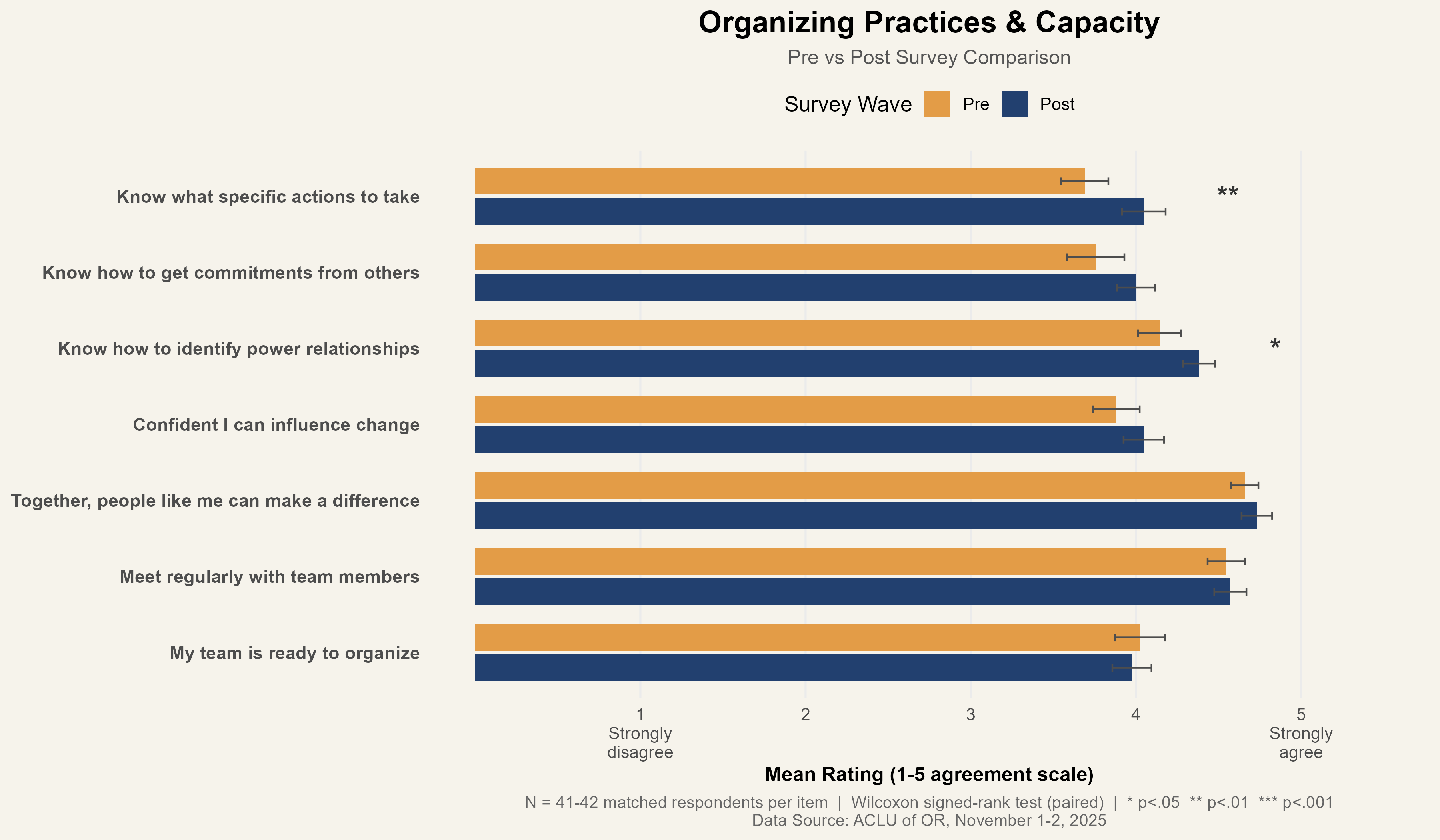
Immediately after the workshop, participants showed statistically significant improvements across all three dimensions of collective agency. Emotionally, they left more hopeful (+21%), more energized (+14%), braver (+7%), and less isolated (−18%). Their orientation toward others shifted markedly: the motivation to recruit others to their organization or campaign nearly doubled (+68%), starting from the lowest baseline of any item measured. The motivation to connect with others who share their values (+17%) and to find a way to plug in (+25%) also increased significantly. Strategically, participants left with greater clarity about what actions they could take (+10%) and stronger ability to identify where power lives in their context (+6%). Taken together, the pattern describes a shift from reactive individual participation toward relational, strategic organizing.

n=43 matched participants · Wilcoxon signed-rank test · Scale 1–5 · % change calculated from pre-workshop baseline · * p<.05 · ** p<.01 · *** p<.001

Emotionally

Emotions pre-post comparison bar chart
Item Before After % Change Sig
I feel hopeful 3.314.02 +21% ***
I feel energized 3.413.90 +14% *
I feel brave 3.864.12 +7% *
I feel isolated 2.552.10 −18% *

Oriented toward others

Motivations pre-post comparison bar chart
Item Before After % Change Sig
Connect w/ others who share my values 3.864.52 +17% ***
Recruit others to my org or campaign 2.173.64 +68% ***
Seek a way to plug in 3.143.94 +25% ***
Feel part of a larger "us" 4.334.63 +7% *

Note: the +68% increase in motivation to recruit others reflects both a large absolute gain (+1.47 points) and a low starting baseline (2.17 out of 5). Participants did not arrive oriented toward bringing others in — and left with that as a primary motivation.

Strategically

Organizing practices pre-post comparison bar chart
Item Before After % Change Sig
Know what specific actions to take 3.694.05 +10% **
Identify power relationships 4.144.38 +6% *

* p<.05  ·  ** p<.01  ·  *** p<.001

The tools traveled
into real organizing.

"I am a new paid organizer after being a volunteer organizer for quite a while. I feel like I finally understand what my job is and how to be more effective in my community." — Rural organizer, post-workshop survey
"I applied the Story of Self in drafting a scholarship application. I'm also applying the challenge/choice/outcome framework as a theme for an upcoming disability rights trial." — Civil rights attorney, six months later
"I was key in getting us to elect a NEW council president, and I'm playing a big role in supporting this new council president in leading in a more collaborative, shared power way." — Elected official, six months later
"We shared the workshop materials with our steering committee and brought in a facilitator to run three strategy sessions. It was so successful that we asked her to run for county commissioner — and now we're running her campaign using the same snowflake leadership model. Every person on the team has a role, and each of them is building their own team beneath them." — Indivisible leader, six months later
"I identified 10 pod leaders, each recruited their own people, and we had about 50 people turn out to wheat paste all of Portland. Someone told me later: 'You're the reason why I'm on the direct action team — because you did such a good training and I really trusted you.' The snowflake model worked... I asked eight people to get arrested and they listened to me. That's kind of scary, but it's exciting." — Youth organizer, six months later
"We used the organizing framework to structure our steering committee and get really organized going into this election cycle. Our county had some big wins — candidates we worked to elect and support are making real change." — Campaign director, six months later
"I wrote the mail piece in the candidate's voice — a direct tie-in from personal story through to the bigger problems we're seeing. Relevant in the most contested Senate race in the state. You have 17 seconds before it goes in the recycling bin. The what and the why have to be there immediately." — Political consultant, six months later
"I had been working on a toolkit for rural Oregon organizing. I went back and looked at my workshop notes several times as I was working through it — 'Oh yeah, oh yeah, oh yeah.' I referenced the story of self/us/now as one of the resources. We can't recruit people into the work if we don't even know why we're doing what we're doing." — Rural organizer, six months later
"I felt a connection back to the reason why I came into organizing. I got an invitation through this weekend to go back to the dreaminess of the work." — Nonprofit organizer, post-workshop survey
"By telling your story, that is how we can start moving towards a collective movement that is able to resist and endure a lot of nos." — Civil rights organizer, six months later

But the training's impact points to a deeper need in the Oregon ecosystem — one that the workshop surfaced and that participants named clearly in the months that followed.

"There were more spaces where there were trainings for organizers that were starting. I do think some of that has been lost. There's folks that have all this knowledge and are so busy holding other things that they might not be able to in the same way that they used to." — Nonprofit organizer, six months later
"The only practice we have with fidelity across the progressive ecosystem is names and pronouns — and everything else we have no common language or approach to. It's really hard to build movement practices if we're unwilling to establish them and then practice them in our organizations." — Foundation executive, six months later
"We haven't yet come to what is our dream. The task upon us is to come back to — can we build a common understanding of what the dream is and then work towards that dream? Instead of just fighting against what we don't like." — City official, six months later

The connections
need a home.

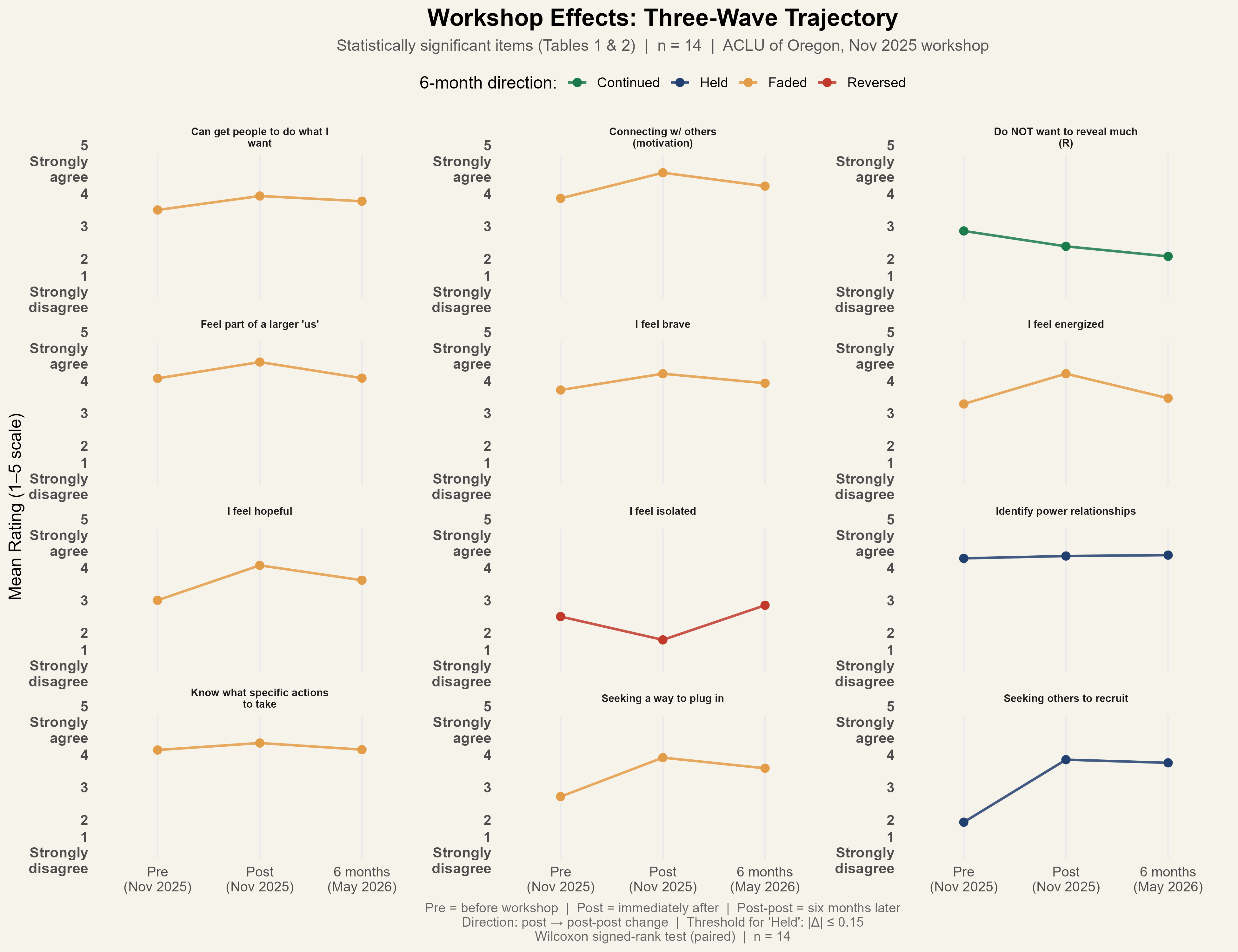
Among the 14 participants who completed all three survey waves, the picture at six months is mixed but telling. The gains most tied to skills and orientation — the motivation to recruit others, strategic confidence, and willingness to share oneself publicly — held or continued to grow. These are internalized dispositions that do not require ongoing relational infrastructure to maintain. What did not hold were the relational and emotional gains: the sense of being part of a larger "us" returned to its pre-workshop baseline, and feelings of isolation reversed to above pre-workshop levels. The workshop built something real. Without follow-up structure to sustain it, that something contracted.

n=14 post-post survey completers · Six-month follow-up · May 2026

Three-wave trajectory chart for all significant items
Six-month trajectories for statistically significant items. Green = continued improving · Blue = held · Orange = faded · Red = reversed below pre-workshop baseline. n=14 post-post survey completers.

Stable or still growing

  • Motivation to recruit others — held stable; the only gain still statistically significant at six months (1.93 → 3.85 → 3.75, p<.05)
  • Strategic confidence — still growing six months later
  • Willingness to share yourself publicly — still growing six months later

Held = gain remained stable at six months. Still growing = continued improving after the workshop without further intervention.

Faded or reversed

  • Feeling energized — significant decline from post-workshop peak (p<.01)
  • Sense of being "part of a larger us" — faded back to pre-workshop levels
  • Feeling isolated — reversed to worse than before the workshop (p<.05)

Faded = declined from post-workshop peak but remained above baseline. Reversed = fell below pre-workshop baseline.

"Without tangible next steps, nothing happens. Without a leadership team, nothing happens. A couple of my projects moved forward easily because they had a leadership team. One moved very slowly because it didn't." — Campaign director, six-month survey
"I do feel more angry and desperate as I watch others do very little and I am exhausted. But I do wonder how long I can sustain this way." — Indivisible organizer, six months later

How do we learn from what worked
and what didn't?

What worked — and must be protected

Multiple participants named story work explicitly as the source of their most significant learning and most durable change.

"We can't recruit people into the work if we don't even know why we're doing what we're doing. The No Kings stuff — we got people out there with 'fuck Trump' signs, but what are we fighting for? What's your purpose? Because when he's gone, he's a symptom of a bigger problem." — Rural organizer, six months later
"Through empathy and discomfort, we built a bond." — Nonprofit staff, six months later
"As a white male, I've never thought about my story. I've suppressed it. The workshop opened a door that I think has made me more grounded and certainly more effective." — Indivisible leader, six months later
"ALL of them, we are all in this together. The course strengthened that bond by the personal stories shared." — Civil rights organization staff, six months later

What to change

Concerns about story work are about how to do it with care and intention. Every participant who raised concerns about the emotional work also said they share the underlying values. The question is how, not whether.

"I think if there were elements of perhaps a quiet sort of writing, rather than requiring everybody to share out everything to the entire group — dedicating more time to internal personal thinking, and then maybe 30% to group discussion. In the workshop I believe it was flipped." — Civil rights organization staff, six months later
"The tactics, the approach, the strategies could be more rooted in trauma-informed care." — Nonprofit staff, six months later
"Public narrative is power — and can put you in a position where you can get doxxed, putting you in danger specifically as women of color. Directly impacted people get to decide what parts of us to share." — Food bank organizer, post-workshop survey
"At a major action debrief, people were calling for campaign planning, storytelling, story of self, one-on-ones, relational organizing. All that expertise is in that room. It's not like the knowledge isn't there — but it has to be someone's job to oversee that stuff. We're all running on fumes right now." — Immigrant rights executive director, six months later
Accessibility ≠ comfort. The goal is not to remove discomfort — it is to ensure the discomfort is generative and consented to.

What the ecosystem needs

The workshop surfaced a broader need that participants named clearly: the Oregon progressive ecosystem lacks shared organizing infrastructure — common language, consistent training, and institutions willing to prioritize the movement over their own organization.

"Oregon does not have grassroots mobilization capacity. I've worked in states where we'll have three, four thousand people on the ground in a given day. Oregon never sees things at that scale. We have all the right entities but we don't have an organizing apparatus that allows us to move these things forward." — Political consultant, six months later
"People who get to the No Kings protests are just focused on what they can't control — this president. But what can you control? Showing up at city council. Making sure children are not in crisis in your community. Knowing your neighbors. Building power around what we can control is hyper local, strong communities that ripple out." — Rural organizer, six months later
"Probably organizing needs to be grounded in trust. What are the ways that trust can be established so that the organizing goes more quickly or effectively? We still need to talk about what does participatory mean — because otherwise we bump up against it and it gets to be, 'I'm not going to raise this.'" — Civic leader, six months later
"Infrastructure has to have the permission of an ecosystem and a sense of ownership by the ecosystem for it to be infrastructure — or else it's just an organization that goes and does a thing. How do we actually get that permission and ownership structure in place?" — Foundation executive, six months later

A path forward:
responsibility and opportunity.

1

Build the infrastructure the connections need.

The workshop created something real. Without follow-up — pods, check-ins, an ongoing structure — it contracts. Participants felt more isolated six months after the workshop than before because the sense of collective belonging had nowhere to live. The host organization has to take responsibility for that container. We built it. We need to sustain it.

"People literally have to prioritize a movement or an ecosystem over their own organization — and that becomes really challenging for any leader who's worried about payroll. If you don't collectively decide, then it is going to be on the funders and the government to decide who survives." — Foundation executive, six months later
2

Build training capacity across the state.

Demand already exists in Southern Oregon, rural communities, immigrant rights organizations, food bank networks. The question is not whether there is appetite. It is whether the host organization will build the infrastructure to meet it.

"I get more and more nervous about the reduction of organization at a personal level, neighborhood level — where people get together in person and engage. These organizations that are popping up should be supported, they should be assisted. The host organization is positioned to assist with that." — Indivisible leader, six months later
3

Keep the emotional and relational work front and center.

"When someone shares even a little their story of self, it is like giving a gift and an opening to the other person and an invitation to be in relationship." — Civil rights organization executive director

The story work, the vulnerability, the coaching practice must not be cut when time is short. They are the mechanism. Keep the discomfort. Distribute it equitably. Pay attention to consent. But do not confuse accessibility with comfort. The productive discomfort is what makes it real.

"The most important work is the work we were talking about because it's transformational, it's not merely transactional." — City official, six months later
"This is just the beginning, not the end." — Civil rights organization executive director, November 2025